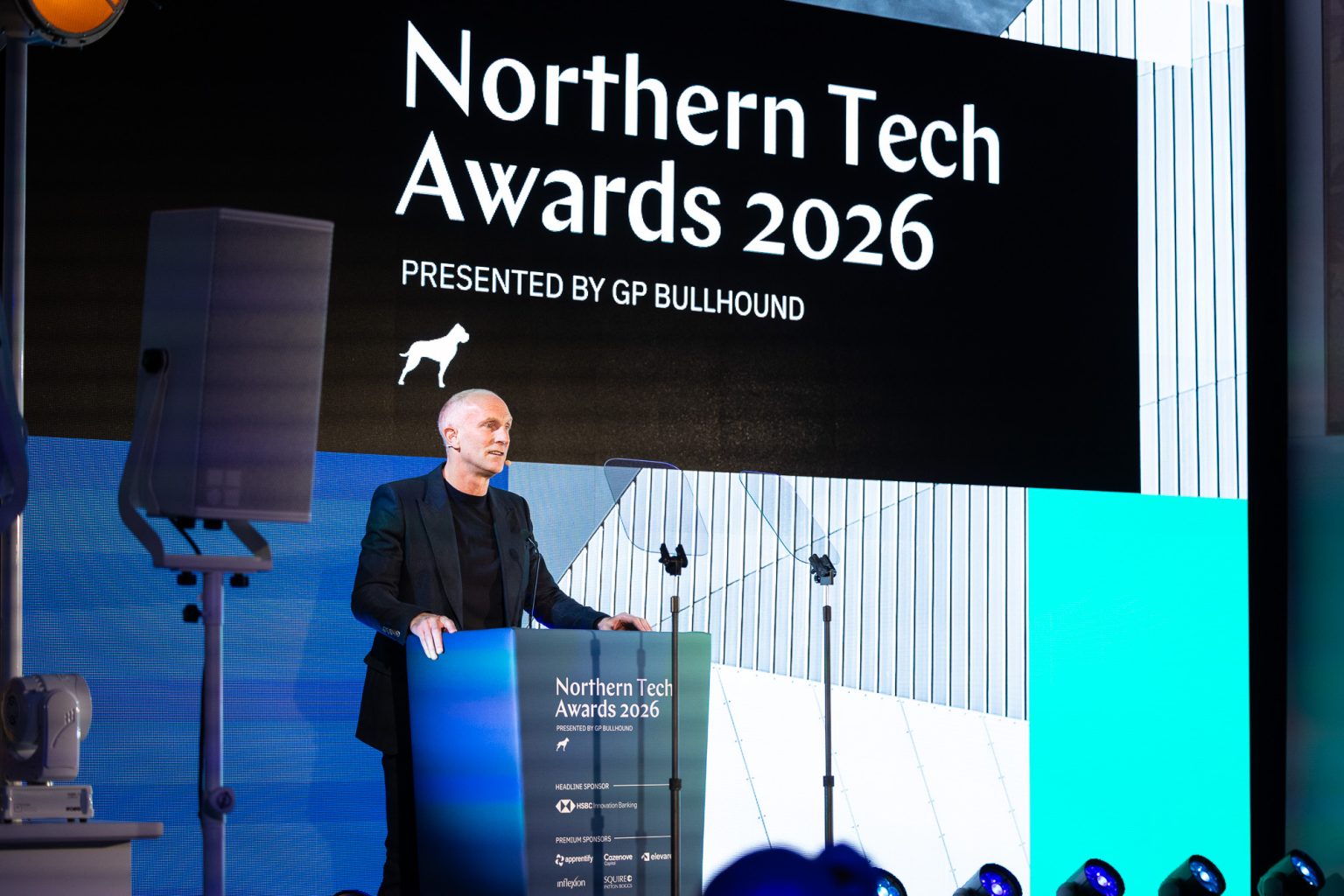
From wars and tariffs to the “saaspocalypse” and a £2.4bn revenue record – Hugh Campbell’s keynote address at the 2026 Northern Tech Awards cut through the noise to ask what kind of future we are actually building, and who gets to benefit from it.
We gathered last week at the Imperial War Museum North. Surrounded, not incidentally, by the machinery of both liberation and destruction, to celebrate the fastest-growing technology companies in the North of England and Scotland. The irony of the venue was not lost on me. Are tanks tech-for-good or tech-for-bad?
It is, without question, a strange world. The stock market sits at record levels while geopolitics reaches new lows. The Magnificent Seven account for 35% of the S&P 500, yet SaaS stocks are down 30%. Whether the Straits of Hormuz are open or closed feels genuinely uncertain from one week to the next.
In this climate, it is easy to be a doomer. Easy to catastrophise. Easy to see AI as the harbinger of a frightening new era of instability rather than the extraordinary enabling force it is also becoming.
“Despite wars and tariffs, the Epstein files and the saaspocalypse — congratulations are in order. All the companies in this room are growing. And growing fast.”
Revenue across our Top 100 reached £2.4 billion in 2025, a Northern Tech Awards record. Standout moments from the past year include the IPO of The Beauty Tech Group, Zuto’s majority investment from Bridgepoint, and Versori’s sale to a US technology company. The region’s story is increasingly a global one: Booking.com now employs over 1,000 developers in Manchester, and Brighton Park, a US software fund, has invested in PortSwigger.
The pace of progress is mind-blowing
It is worth pausing to take stock of what humanity is actually achieving right now. Four astronauts have safely returned to Earth after travelling a record 250,000 miles. Nvidia is within reach of a $5 trillion valuation. Quantum computing is becoming a commercial reality. And the latest frontier AI models are beginning to expose structural weaknesses in systems, from global banking to protein biology, that have resisted human analysis for decades.
Access to the most advanced AI models is now, in many respects, akin to accessing rare earth metals — scarce, strategically vital, and fiercely competed over.
When I gave this address in 2022, I spoke about AI’s potential to transform “every aspect of society.” What I underestimated, dramatically, was the speed. In 2022, these systems struggled with basic arithmetic. Today they are being deployed in front-line military applications, used in complex protein-folding research, and rapidly shedding the hallucinations that once made them unreliable. That leap, from novelty to critical infrastructure, happened in four years.
“That acceleration, from novelty to critical infrastructure, for better or for worse, has happened in only four years.”
A horizontal enabling layer, but who benefits?
As an optimist, I have long believed in the power of technology to drive meaningful change. My view of AI is no different. The problems we face as a species — climate change, cancer, food poverty, an ageing population — are all areas where super-intelligence could make a transformative difference. As Jeff Bezos has put it, AI is best understood as a horizontal enabling layer: a force that can touch every field and every person.
But there are real, legitimate concerns that deserve honest attention. I will skip the scenario where robots murder us in our sleep and focus on the more immediate one: jobs.
It is extraordinary to me that our politicians spend more time worrying about small boats crossing the Channel than about the structural impact of AI on our labour market. UK youth unemployment currently stands at 16% — an 11-year high — driven by too many graduates, economic pressure, and the accelerating adoption of AI. My own daughter graduated this year into what can only be described as job search hell: her AI-powered CV agent locked in an arms race with a plethora of AI recruitment agents. So far, no result.
Here is some quick maths. The value of global labour is roughly $60 trillion per year. If, over the next decade, AI can perform 20% of that work at 10% of the cost, that is $10 trillion in profit up for grabs. An extraordinarily attractive prize — for both incumbents and start-ups alike.
It is already playing out. Jack Dorsey announced that his fintech is cutting headcount by 50% to implement an AI-driven operating model. Morrisons has announced hundreds of job cuts as part of an AI push. In my own industry, as much as 60% of junior analyst work can now be automated — and it will not be long before that figure is 90%.
The picture is nuanced, though. In software engineering — the sector most exposed to automation — job openings in the US have actually increased, returning to levels seen two years ago. But crucially, that growth is almost entirely at the senior end: roles commanding £100,000 or more. What this tells us is that AI is acting as a complement to expertise, enhancing the productivity of those with deep experience, while simultaneously replacing the entry-level work that has traditionally served as the training ground for the next generation.
The future of work should be written by people
What does the future of work actually look like? Humans are an adaptable species. As with every previous technological wave, advanced AI will generate new roles we cannot yet imagine — Prompt Engineers, AI Strategists, Chief AI Officers, and my current favourite: AI Sherpas. Whether these materialise fast enough to offset the losses is an open question. We may yet see a brake on AI diffusion from regulation, inertia, or simply a lack of compute.
One likely outcome is that more people will need to become entrepreneurs. Partly from necessity, fewer knowledge-economy jobs, and partly from opportunity: it has never been cheaper or simpler to turn an idea into a business. When GP Bullhound started 25 years ago, the barriers to founding a tech company were substantial. Today, between cloud computing and AI, the cost and complexity of building something real has fallen dramatically. Perhaps our Top 100 can one day become a Top 1,000.
“Old walls are tumbling down, and in the rubble a new world is being built by founders with curiosity, speed, and the courage to try.”
But if left unchecked, the productivity gains from AI will disproportionately reward those who already hold capital. History is clear on this: extreme inequality generates public anger and civil unrest. In the United States, the early signs of a populist backlash are already visible, from communities blocking new data centres and copyright lawsuits to Hollywood strikes and deepfake legislation.
The temptation for founders and executives will be enormous: cut headcount, reduce training budgets, stop internships, chase margin. But we must ask ourselves what kind of future we are building in the process. We have a duty, as the people shaping this technology, to ensure that as it transforms the world, no one is left behind.
Reasons to be confident
The UK has the fourth highest number of AI researchers globally. Sir Demis Hassabis, founder of DeepMind, is just one of many brilliant British minds working at the frontier. We have some of the world’s great universities and a pioneering tradition that most nations would envy.
And if, as Dario Amodei of Anthropic has suggested, we are in the adolescence of a new technological age, then the room at the Imperial War Museum last night was exactly the kind of room that can navigate us through this messy middle of AI puberty into something better on the other side.
In such a fast-moving, disorienting world, my own approach is simple. Focus on what you can control, and that is not the Straits of Hormuz. Embrace the advantages of AI productivity while thinking carefully about bringing your fellow humans along for the ride. And, above all, take to heart the words of Douglas Adams:
“Don’t panic.” – The Hitchhiker’s Guide to the Galaxy, Douglas Adams
Congratulations to every founder, team, and company recognised at the 2026 Northern Tech Awards. The ambition in that room is the North’s greatest asset.
Related Articles