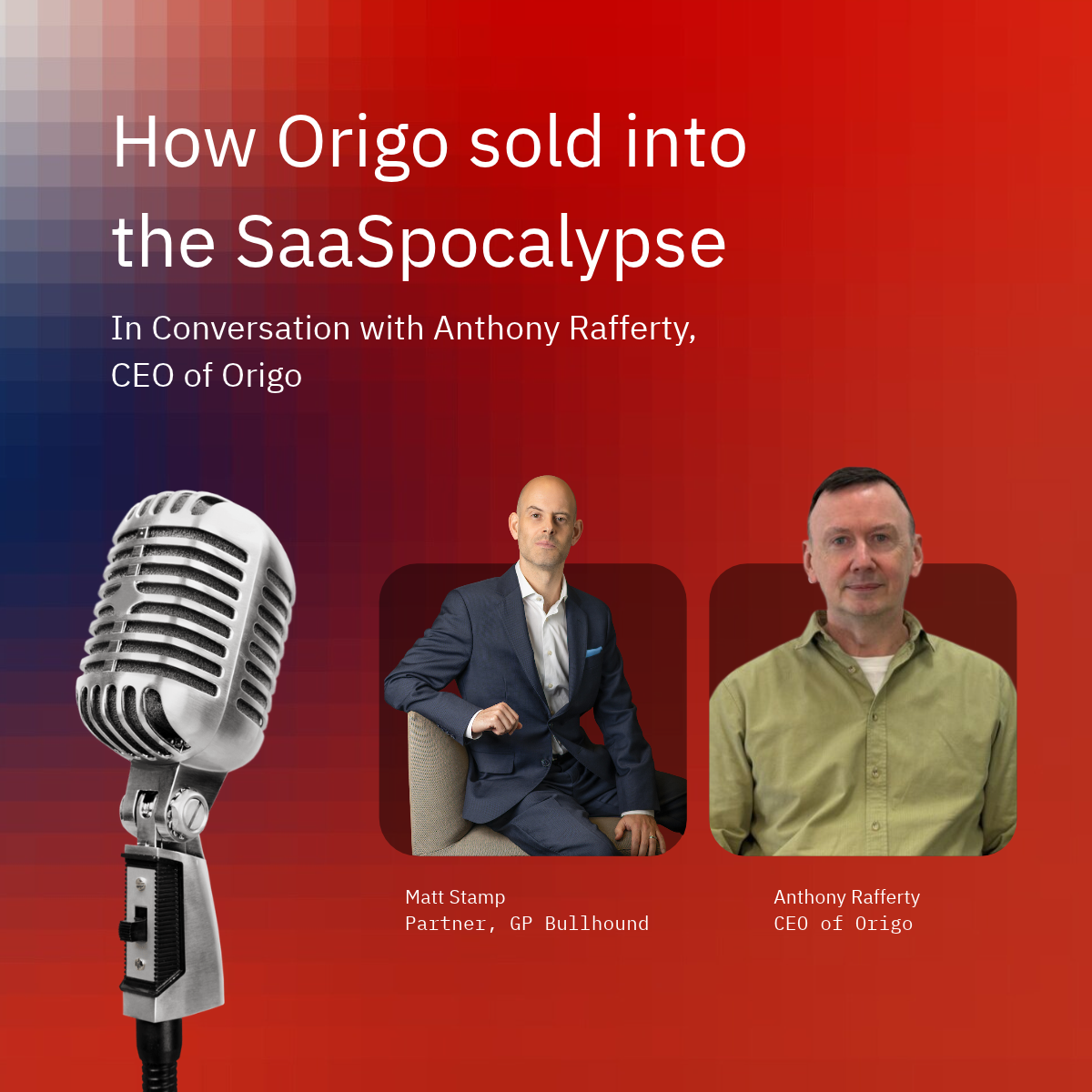
Anthony Rafferty, CEO of Origo, on carving a 38-year-old fintech out of industry ownership, building the UK’s pension dashboard, and selling to iPipeline in a market that had written software off.
Twelve months ago the consensus was that software was finished. AI would eat the application layer, multiples would compress, and anyone holding a SaaS asset should sit tight and wait for better weather.
Origo sold anyway — to iPipeline, a Roper Technologies company — after a competitive process that ran for only six weeks to preferred bidder status.
In the latest GP Bullhound podcast, Matt Stamp, Partner and Head of Fintech and Software, sat down with Origo CEO Anthony Rafferty a couple of weeks after the deal was inked. What follows is an unusually candid account of what it actually takes to get a software deal done in 2026.
The original fintech
Origo is 38 years old, born in the same year as the World Wide Web. It was founded by a group of life, pensions and investment businesses looking for ways to take friction out of how they dealt with each other — in the days of paper, post and wet signatures. That remit hasn’t changed. Today Origo runs pension transfers, an integration hub, and Unipass, the identity service that gives around 50,000 financial advisers single-click secure access to the portals they use every day.
When Rafferty joined at the start of 2018, the business was still owned by twelve of its largest customers and ran on a not-for-profit ethos. What he found was not what the ownership structure suggested.
“What I found was a business full of really talented people who were actually quite commercial — but constrained by its former ownership.”
The constraint was structural rather than cultural. Being owned by twelve mostly FTSE 100 businesses made decision-making slow, and made asking for growth capital a very difficult conversation.
Independence, then cadence
So the leadership team went after independence — to streamline the governance, raise capital, and diversify the product set. The route out was an MBO with Vespa Capital, completed in the first half of 2022.
Origo ran a proper process to choose its sponsor, screening not just for track record in product-led businesses but for cultural fit. Vespa came out on top on both.
What changed after independence was pace. The business had been too reliant on its two largest services, so the strategy was to diversify and grow. A Chief Product Officer came in, sales, marketing and HR were built out, and the cadence of new product development stepped up sharply.
“That’s really the secret sauce over the last four years — increasing the cadence of our new product development.”
By 2026 Origo had the profile buyers pay for: fast-growing newer services still early in their trajectory, alongside mature services compounding on legislative and demographic tailwinds.
The biggest pension project in UK history
Origo is building the central digital architecture for the UK pensions dashboard — the system that will let anyone in the UK identify themselves online and see every pension they hold, on one screen, with an indication of their retirement income.
“The average person now retires with eleven pension pots. Eleven different statements, all speaking different languages.”
The architecture runs the search across the industry, matches the individual, and returns up-to-date values securely — the right data, in the right place, at the right time. Four years in the making, it goes live next year.
For buyers, this was more than a contract. It positioned Origo as an architect of a structural shift in UK defined contribution pensions, not merely a supplier to it.
Defensible to AI — and a catalyst for it
AI came up in effectively every one of the roughly 200 meetings held across the process. Origo’s answer was structural rather than rhetorical: it is a network-effect business that moves clean, verified data between industry participants.
“It wasn’t difficult to explain how defendable the business was. And indeed, actually we can help — accurate data in the right place at the right time is what AI needs. So it was very much: there’s not going to be a problem for you here, let’s talk about the opportunities.”
On the wider market gloom, Rafferty is blunt.
“The fundamentals are still the same. SaaS businesses you could vibe code in an hour — that’s vulnerable. We just weren’t, because of the network effects and because we’re the ones that improve the data and pass it to the right place.”
A quiet M&A market, he suspects, may even have worked in Origo’s favour — fewer quality assets competing for buyer attention.
Four factors that got the deal done
From Matt Stamp’s side of the table, Origo cleared four bars that are becoming the price of entry for an outsized outcome:
- Defensibility to AI — provable, not asserted.
- Offensive AI upside — a credible route to building AI into the model.
- Efficient growth — the rule of 40 has moved. Rule of X, and the number is 70, 80, 90.
- Structural market opportunity — with a defined role in it, not just exposure to it.
Method mattered too. Several months of detailed preparation and careful pre-marketing with a select group established whether the market was open before the team and advisors committed to a process. Only then did the process run — fast, and to a small, highly focused group of trade buyers and investors.
“We tested it first, got the right answers and then pressed the button and moved quickly. That’s the secret of the success.”
The shortlist was deliberately diverse. Depending on the angle — data, software, end-market, growth — UK wealth and pensions looks like a different opportunity, so no two conversations were the same. Several of the unsuccessful parties have since re-engaged as potential commercial partners.
Why iPipeline
Rafferty is direct about the preferred outcome.
“Right from the start, we wanted it to be iPipeline. They were asking more questions about our culture than anyone else. So they deeply cared about that.”
The strategic logic is straightforward: adjacent markets, life insurance and wealth, both with significant UK presence and almost no overlap. Origo’s 50,000 daily Unipass advisers typically don’t distribute life insurance — and iPipeline has the quote engine. Roper’s global footprint makes international expansion look materially easier.
Since completion, the signals have stayed good. The iPipeline and Roper leadership team came into the Edinburgh office early, met people collectively and individually, and made themselves present in the business.
“Those green flags have just continued. I think we’re in very good hands.”
The advice
Asked what he now tells the chief executives who call him, Rafferty’s answer is consistent.
“The number one thing I tell them is to pick good investment bankers— and not just because they’re good and they lead the process well and they find the right companies. But actually it legitimises the process. Almost the minute that we picked the right advisers is the minute that you get the traction and the movement.”
His second point is about how you pick them: be selfish, be in the detail, do your due diligence, take references — and go and meet those referees in person.
GP Bullhound advised Origo and Vespa Capital on the sale of Origo to iPipeline, a Roper Technologies company, alongside Oliver Wyman, EY and DLA Piper.
Listen to the full conversation on the GP Bullhound podcast.
Related Articles