Consumer software is not dead – but the economics have changed.
AI has made an impressive first product experience dramatically easier to create, but winning a return to the second session harder than ever. More than 100,000 iOS apps are being launched each month, and while AI apps are generating 41% more revenue per paying user, they are churning 30% faster than non-AI apps. The result is a market with more supply, more capability, and more competition for the same finite consumer attention.
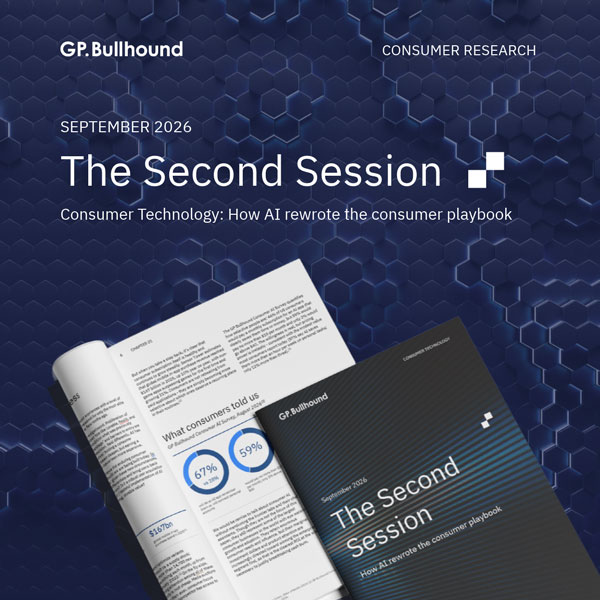
“The Second Session” examines where durable value is now being created: frontier labs are largely focused on the enterprise while leaving white space for specialists, consumer companies are shifting from capturing superficial installs to earning deeper, habitual engagement, and retention, trust, and inference economics are becoming the real underwriting test. The report draws on the GP Bullhound Consumer AI Survey of US consumers, the consumer AI transaction record, and our experience advising consumer subscription businesses.
“AI is creating an extraordinary new chapter for consumer technology. It is lowering the barrier to building products with genuinely magical first experiences, while simultaneously raising consumer expectations for speed, personalization and quality. We are seeing new categories emerge in creative tools, agents and AI companions, while established consumer businesses are finding new ways to deepen their relationships with users through AI. But the defining challenge remains the same: can you give consumers a reason to come back? We call that the ‘Second Session’ – the point at which initial curiosity starts to become a real long term product relationship.” Pierce Lewis-Oakes, Managing Director at GP Bullhound
Key Insights
Four themes reshaping consumer technology
| 01 / CONSUMER TECHNOLOGY: THE CURRENT STATE OF PLAY |
- The frontier labs are increasingly directing their investment and product attention towards enterprise, leaving white space for startups to build generational consumer businesses
- 74% of US consumers say trust in the company matters more than how advanced its AI is, an opening for specialists that earn it
- 100,000+ new iOS apps now launch every month; building has never been cheaper, and distribution and differentiation have become the defining challenge
| 02 / HOW CONSUMER COMPANIES WIN |
- The distinction between AI-native and AI-enabled businesses has broad implications for how operators position and how investors underwrite
- A large dataset does not automatically become a moat; the defensible asset is a vertical context loop that improves with repeated use and is costly to rebuild elsewhere
- The capability-adoption gap is the largest opportunity in the category, with advanced agentic capability running ahead of consumer-grade packaging
| 03 / THE GROWTH PLAYBOOK |
- Consumer businesses are either treadmills, which slow the moment paid spend stops, or conveyor belts, which compound without having to buy users back
- A first “wow” moment is now table stakes; novelty drives downloads, only utility earns a return visit
- Personalisation has moved from feature to admission price, with the second session emerging as the first genuine evidence that a product created a reason to return
| 04 / THE SCORECARD AND THE EXIT |
- The metrics haven’t changed, but the bar has; now that AI is seen as a real threat to product moats, consumer businesses are being underwritten against best-in-class benchmarks
- KPIs are the main drivers of valuation, with premium multiples going to flattening cohorts, margins that hold after inference costs, organic user acquisition and payback measured in months
- The moat a company chooses to build is, in effect, a choice of acquirer, with incumbents, frontier labs, global media, scaled AI natives and financial sponsors each looking for different acquisition targets
Related Articles